
A journey on foot through Bhutan's most storied valleys, sacred cliffside monasteries, and high alpine lakes.
The Druk Path Trek through Bhutan
10 Days | 9 Nights
Paro – Jili Dzong – Rabana – Jimilang Tsho – Labana – Thimphu – Punakha – Paro
Trekking, Culture, Adventure, Nature
Bhutan trekking, Druk Path Trek, Himalayan trek, Paro Thimphu Punakha, Tiger's Nest, Bhutan camping trek, Himalaya Bhutan tour


The Essence
Consistently voted the happiest country in the world, Bhutan sits at the far eastern end of the Himalayas, its doors barely open to outsiders since the 1970s and its culture guarded by a strict philosophy of sustainability. What remains is a kingdom of astonishing authenticity — dzong-fortresses and temples clinging to sheer cliff faces, prayer flags strung across high mountain passes, and a predominantly Buddhist way of life largely untouched by the modern world. The landscape shifts dramatically along the way, from the sub-tropical valleys and terraced rice fields of Punakha to the alpine lakes and 4,000-metre passes of the Druk Path, all the way up to snow-capped Himalayan peaks. This is the Land of the Thunder Dragon: a place where legend, landscape, and living faith are inseparable.
Key Highlights
- The hike to Taktshang Monastery (Tiger’s Nest), Bhutan’s most sacred site
- Six days of trekking across the historic Druk Path, past Jimilang Tsho and Simkotra Tsho
- Phume La Pass at 4,230 metres, the highest point of the trek
- The magnificent Punakha Dzong and the 108 chortens of Dochula Pass
Ten days across the roof of the Himalayas — from the sacred cliffs of Tiger’s Nest to the fortress valleys of Punakha. Trek the ancient Druk Path past Jimilang Tsho and Simkotra Tsho, camp beneath prayer flags among Bhutan’s yak herders, and cross Phume La Pass at 4,230 metres, the trek’s highest point. Descend into Thimphu’s dzongs and Buddha Dordenma, then wind through Dochula Pass and its 108 chortens to Punakha, where the Pho Chhu and Mo Chhu rivers meet beneath the kingdom’s most spectacular fortress. This is Bhutan on foot — wild, sacred, and unforgettable.

Amankora
Thimphu
Amankora Gangtey Lodge
Gangtey
Amankora
Punakha
Amankora Paro Lodge
Paro District
Itinerary
Day 1
Paro District
Arrive Paro
The flight to Paro is widely regarded as one of the most spectacular journeys in the Himalayas. Whether approaching along the Himalayan range from Kathmandu or over the lush foothills from Kolkata, the flight offers breathtaking panoramic views and an unforgettable descent into the Kingdom of Bhutan.
Upon arrival at Paro International Airport, you will be welcomed by the fresh mountain air and greeted by our representative after completing immigration formalities and collecting your baggage. You will then be transferred to your hotel for check-in.
Located in the northwestern region of Bhutan, the picturesque Paro Valley is renowned for its stunning landscapes, rich cultural heritage, and fascinating legends. It is home to many of Bhutan’s oldest temples and monasteries, the country’s only international airport, and the National Museum, making it one of the kingdom’s most significant cultural destinations.
Later, enjoy a leisurely stroll through Paro’s charming main street and local market, where you can experience the relaxed pace of Bhutanese life and browse traditional handicrafts and local products.
Continue your visit to Kyichu Lhakhang, one of Bhutan’s oldest and most sacred temples. Built in the 7th century by the Tibetan King Songtsen Gampo as one of the legendary 108 temples constructed across the Himalayas, Kyichu Lhakhang marks the arrival of Buddhism in Bhutan and remains an important pilgrimage site.
Day 2
Paro District
Paro
After breakfast, embark on a memorable hike to the iconic Taktshang Monastery (Tiger’s Nest), one of Bhutan’s most revered landmarks. The hike takes approximately 5 hours (round trip) and rewards visitors with spectacular views of the Paro Valley. Perched dramatically on a sheer cliff face, about 900 metres above the valley floor, Tiger’s Nest is considered Bhutan’s most sacred monastery. According to legend, Guru Rinpoche flew to this site on the back of a tigress and meditated here, giving the monastery its famous name. Visited by Zhabdrung Ngawang Namgyal in 1646, it remains one of Bhutan’s most important pilgrimage sites and a place every Bhutanese hopes to visit at least once in their lifetime.
Later in the afternoon, drive to the northern end of the Paro Valley to visit Drukgyel Dzong, a magnificent 17th-century fortress originally built to commemorate Bhutan’s victory over Tibetan invaders. Beautifully restored after being partially destroyed by fire in the 1950s, the fortress once again stands as a symbol of Bhutan’s rich history and architectural heritage.
Continue with a visit to a traditional Bhutanese farmhouse, known for its vibrant paintings, intricate woodwork, and unique construction without the use of a single nail. This authentic experience offers a fascinating glimpse into rural Bhutanese life, where families continue to live in harmony with nature, surrounded by terraced fields of rice, maize, and buckwheat, preserving centuries-old customs and traditions.
Day 3
Paro District
Paro – Jili Dzong
Distance: 4 km | Trekking Time: 2–3 hours | Ascent: 570 m | Descent: 30 m | Camp Altitude: 3,575 metres
After breakfast, visit the magnificent Rinpung Dzong, also known as the “Fortress of the Heap of Jewels.” One of Bhutan’s finest examples of traditional architecture, the dzong is renowned for its impressive courtyards, intricately carved wooden galleries, and beautifully preserved murals depicting Buddhist philosophy and folklore. Highlights include the Four Friends, the Wheel of Life, the Old Man of Long Life, scenes from the life of Milarepa, Mount Sumeru, and elaborate cosmic mandalas. The fortress also gained international recognition as a filming location for Bernardo Bertolucci’s acclaimed movie Little Buddha.
Continue to Ta Dzong, Bhutan’s National Museum, which houses an outstanding collection of cultural and historical artefacts. Its exhibits include ancient relics, sacred thangka paintings, traditional handicrafts, ceremonial masks, royal costumes, armour, and Bhutan’s famous postage stamps, providing a fascinating introduction to the kingdom’s rich heritage and artistic traditions.
Later, drive along a mountain road to the trek starting point at approximately 3,050 metres, where you will meet your trekking crew and pack horses. Begin your trek through peaceful forests of blue pine, fir, and rhododendron, gradually ascending towards Jili La Pass (3,575 metres). Along the way, enjoy refreshing mountain air and beautiful views of the surrounding valleys.
Upon reaching the pass, take in spectacular panoramic views of Jili Dzong and the rugged Himalayan landscape. Your campsite is set in a tranquil alpine meadow just below the pass. If time permits, enjoy a short walk to the nearby prayer flags overlooking the Paro Valley, offering breathtaking sunset views and a peaceful introduction to Bhutan’s wilderness.
Day 4
Paro District
Jili Dzong – Rabana
Distance: 10 km | Trekking Time: 6–7 hours | Ascent: 440 m | Descent: 225 m | Camp Altitude: 3,890 metres
After breakfast, retrace the ridge to Jili Dzong, an ancient fortress that once served as an important resting point along the historic trade route connecting Paro and Thimphu. During the summer months, a small community of monks resides here, and, if circumstances permit, you may have the opportunity to visit the monastery. Colourful prayer flags fluttering around the dzong create a peaceful atmosphere and provide an excellent backdrop for photographs.
Continue your trek along a scenic ridgeline, following a gently undulating trail that crosses a series of mountain spurs before descending through dense forests of fir and rhododendron. As the trail emerges into open alpine meadows, enjoy spectacular panoramic views overlooking the Thimphu Valley and the surrounding Himalayan landscape.
Pause for a freshly prepared hot lunch in one of the picturesque mountain meadows before continuing towards Rabana. Arrive at your campsite by mid-afternoon, beautifully situated on a high ridge at an altitude of 3,890 metres. On clear days, the campsite offers magnificent views across the valleys and distant mountain ranges, making it an ideal place to relax and soak in the tranquillity of Bhutan’s pristine wilderness.
Day 5
Paro District
Rabana – Jimilang Tsho
Distance: 9 km | Trekking Time: 6–7 hours | Ascent: 430 m | Descent: 490 m | Camp Altitude: 3,830 metres
After breakfast, continue your trek through fragrant conifer forests and picturesque stands of dwarf rhododendron, gradually ascending into Bhutan’s breathtaking alpine landscape. The trail leads to Jangchu La Pass (4,190 metres), where you are rewarded with spectacular panoramic views of the surrounding valleys and, on clear days, the snow-capped peaks of the eastern Himalayas.
From the pass, enjoy your first glimpse of Jimilang Tsho (Sand Ox Lake), shimmering far below amidst the pristine mountain scenery. While the main trail continues towards the remote fortress of Lingshi, today’s route descends steeply to the tranquil lakeshore at an altitude of 3,830 metres.
Steeped in local folklore, Jimilang Tsho is believed to be the home of a mystical sand ox. According to legend, local farmers bring their cattle to graze near the lake in the hope that the mythical creature will bless them with strong and healthy offspring. Surrounded by dramatic mountain landscapes and crystal-clear waters, the lake is also well known for its abundance of trout and its peaceful atmosphere.
Your campsite is beautifully located beside the shores of this enchanting alpine lake, providing the perfect setting to relax and immerse yourself in the serenity of Bhutan’s untouched wilderness.
Day 6
Paro District
Jimilang Tsho – Janye Tsho – Simkotra Tsho – Labana
Distance: 9 km | Trekking Time: 6–7 hours | Ascent: 530 m | Descent: 230 m | Camp Altitude: 4,110 metres
After breakfast, continue your trek along a well-defined mountain trail, crossing a series of scenic ridges and gentle passes. The day begins with a gradual ascent to Janye Tsho, a beautiful alpine lake nestled amidst rolling highlands. The route passes through extensive patches of dwarf rhododendron, which transform the landscape into a vibrant display of colour during the spring flowering season.
Continue onwards to the larger and equally picturesque Simkotra Tsho, surrounded by dramatic mountain scenery and pristine alpine meadows. From here, ascend to a saddle at approximately 4,180 metres, where magnificent views of the rugged Himalayan landscape unfold in every direction.
This high-altitude region is home to Bhutan’s traditional yak herders, and it is common to encounter their grazing herds along the trail. These nomadic communities have followed seasonal migration patterns for generations, preserving a unique mountain lifestyle. The area is also renowned for Cordyceps, a rare and highly valued medicinal fungus that grows naturally at these elevations and is sustainably harvested by licensed local herders during the summer months.
A gentle descent from the pass brings you to Labana Camp (4,110 metres). The name Labana translates to “between two passes,” reflecting its location between the surrounding mountain crossings. From the campsite, you can see Phume La Pass (4,230 metres), the highest point of the trek, which you will cross the following day. The peaceful alpine setting and sweeping mountain views provide a memorable end to another rewarding day on the trail.
Day 7
Paro District
Labana – Phajoding Goemba – Thimphu
Distance: 12 km | Trekking Time: 6–7 hours | Ascent: 100 m | Descent: 1,400 m | Altitude (Thimphu): 2,280 metres
After breakfast, bid farewell to your trekking crew and begin the final day of your trek with a short ascent to Phume La Pass (4,230 metres), the highest point of the journey. Marked by a traditional stone cairn draped with colourful prayer flags, the pass offers spectacular panoramic views of the eastern Himalayas. On a clear day, you may enjoy breathtaking vistas of Mount Jomolhari and Gangkar Puensum, the world’s highest unclimbed mountain. From here, take in a magnificent bird’s-eye view of Thimphu Valley stretching out below.
Begin your descent to Phajoding Goemba (3,700 metres), one of Bhutan’s most important mountain monasteries. Founded in the 15th century, this peaceful monastery is renowned for its spiritual significance, traditional architecture, and tranquil setting overlooking the capital valley. Enjoy a scenic lunch en route before continuing your descent through serene forests of pine and rhododendron until you reach the roadhead.
Upon arrival, meet your vehicle and transfer to Thimphu, Bhutan’s vibrant capital city. If time permits, visit the Motithang Takin Preserve, home to Bhutan’s unique national animal, the Takin, an unusual species found only in the eastern Himalayas.
Later, visit the impressive Tashichho Dzong, the “Fortress of the Glorious Religion.” This magnificent fortress-monastery serves as the administrative and religious heart of Bhutan, housing the King’s Throne Room, the Secretariat, several government offices, and the summer residence of the Chief Abbot and the Central Monastic Body. With its striking Bhutanese architecture and beautifully maintained courtyards, it stands as one of the country’s most iconic landmarks.
Day 8
Paro District
Thimphu – Punakha (75 km | Approx. 2.5 hours drive)
After breakfast, begin the day with a visit to the magnificent Buddha Dordenma, one of the world’s largest seated bronze Buddha statues. Standing 201 feet (61 metres) tall, the statue overlooks the Thimphu Valley from Kuenselphodrang Nature Park and offers spectacular panoramic views of the surrounding mountains. Consecrated in 2015, it commemorates the 60th birth anniversary of His Majesty the Fourth Druk Gyalpo and is one of Bhutan’s most important spiritual landmarks.
Continue to the King’s Memorial Chorten, a revered monument built in memory of His Majesty King Jigme Dorji Wangchuck, the Third King of Bhutan and the Father of Modern Bhutan. The chorten is one of the country’s most significant religious sites, where devotees gather daily to offer prayers, spin prayer wheels, and perform circumambulations.
Next, visit the National Textile Museum, which showcases Bhutan’s rich weaving traditions and textile heritage. Established under the patronage of Her Majesty Queen Ashi Sangay Choden Wangchuck, the museum features an impressive collection of traditional fabrics, royal garments, sacred textiles, and intricate handwoven masterpieces, offering valuable insight into one of Bhutan’s most cherished cultural arts.
Later, drive to Punakha via the spectacular Dochula Pass (3,088 metres). Weather permitting, enjoy breathtaking panoramic views of the eastern Himalayas, including Masagang (7,158 m), Tsendagang (6,960 m), Terigang (7,060 m), Jejegangphugang (7,158 m), Kangphugang (7,170 m), Zongphugang (7,060 m), and Gangkar Puensum (7,570 m), the highest unclimbed mountain in the world.
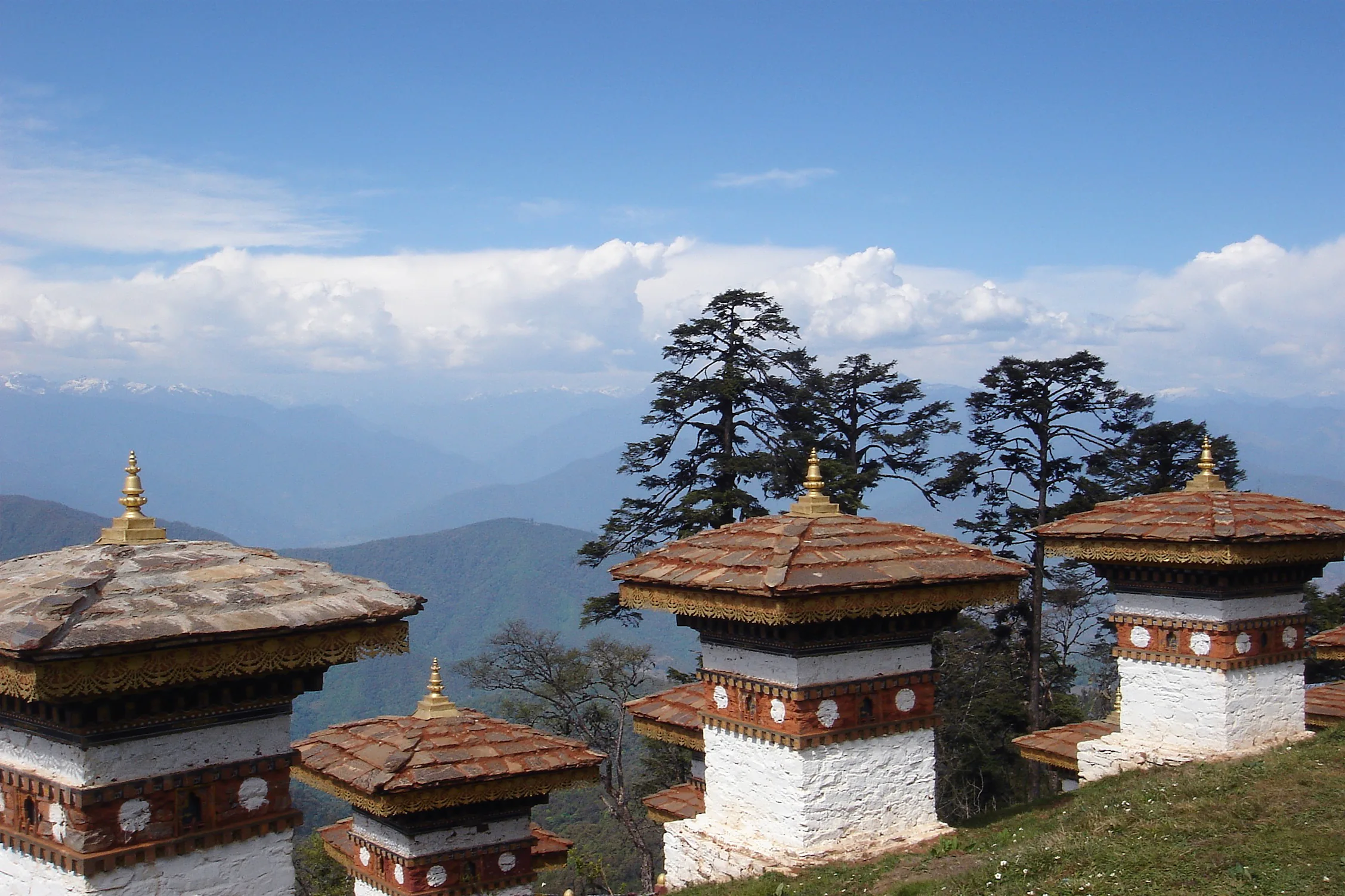
At the summit of the pass, visit the iconic 108 Druk Wangyal Chortens, built by Her Majesty the Queen Mother Ashi Dorji Wangmo Wangchuck. These beautifully arranged white stupas, adorned with colourful prayer flags, create one of Bhutan’s most photographed and spiritually significant landmarks.
Continue your scenic drive through forests and mountain valleys to Punakha, the ancient capital of Bhutan until 1955. Nestled at the confluence of the Pho Chhu (Male River) and Mo Chhu (Female River), Punakha remains the winter residence of the Je Khenpo, Bhutan’s Chief Abbot. Located at an altitude of 1,300 metres, the valley enjoys a pleasant subtropical climate and is renowned for its fertile farmland
Day 9
Paro District
Punakha – Paro (125 km | Approx. 4 hours drive)
After breakfast, visit the magnificent Punakha Dzong, one of Bhutan’s most spectacular fortresses, beautifully situated at the confluence of the Pho Chhu (Male River) and Mo Chhu (Female River). Built in 1637 by Zhabdrung Ngawang Namgyal, the dzong served as Bhutan’s religious and administrative centre for centuries and remains one of the country’s most significant historical landmarks. Despite suffering damage from fires and earthquakes over the years, it has been meticulously restored and continues to showcase Bhutan’s finest traditional architecture.
Next, enjoy a leisurely walk through picturesque rice fields and traditional villages to Chimi Lhakhang, a charming hilltop temple dedicated to Lama Drukpa Kuenley, the legendary 15th-century saint affectionately known as the “Divine Madman.” Renowned for his unconventional teachings delivered through humour and wisdom, he remains one of Bhutan’s most beloved spiritual figures. Chimi Lhakhang is also celebrated as the Temple of Fertility, attracting couples from around the world who visit to seek blessings for children.
Later, drive back to Paro, retracing your journey over the scenic Dochula Pass and following the picturesque valleys of the Wang Chhu and Paro Chhu rivers.
En route, visit Simtokha Dzong, the oldest surviving dzong in Bhutan. Built in 1629 by Zhabdrung Ngawang Namgyal, this historic fortress—officially known as Sangak Zabdhon Phodrang (Palace of the Profound Meaning of Secret Mantras)—was the first dzong constructed in Bhutan. Today, it serves as an important centre for Buddhist studies while preserving its remarkable architecture and rich cultural heritage.
Continue your drive to Paro and check in at your hotel.
Day 10
End of Itinerary
Depart Paro
After breakfast at the hotel, you will be transferred to Paro International Airport in time to board your onward flight.
As you bid farewell to the enchanting Kingdom of Bhutan, take with you unforgettable memories of majestic Himalayan landscapes, sacred monasteries perched high on mountain cliffs, vibrant traditions, and the genuine warmth of Bhutanese hospitality. May the serenity, spiritual richness, and timeless charm of the Land of the Thunder Dragon remain with you long after your journey comes to an end.
We thank you for choosing to travel with us and wish you a safe journey and pleasant onward travels.
End of Services

The Thunder Dragon's Trail
Stay Inspired, Stay Connected
Join our community to receive destination highlights, travel insights, and curated experiences delivered straight to your inbox.